


Women at the Center
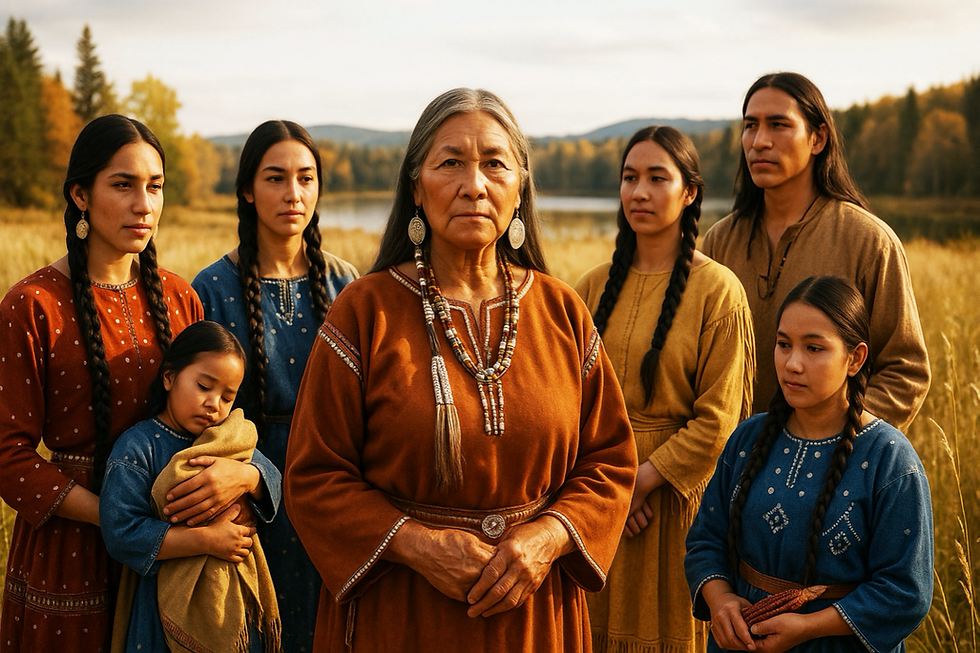
Reflections on Native American Partnership Culture
By Geoffrey Holland
For thousands of years before European colonization reshaped the North American continent, Indigenous cultures lived within social structures that differed profoundly from the domination-heavy systems that would later overtake them. Far from being marginal, women across many Native American nations were essential to governance, diplomacy, ecological stewardship, and the preservation of culture. Their roles were woven into a broader worldview—a partnership culture—that saw life not as a hierarchy of power, but as a web of relationships. In that Indigenous worldview, women’s authority was not an exception. It was foundational.
This essay reflects on that partnership orientation and highlights several historically memorable women leaders whose stories illuminate what flourishing societies can look like when gender balance, mutual respect, and communal responsibility guide the way.
A Partnership Foundation: Balance, Reciprocity, and Relational Power
While no single description fits all Indigenous nations—each with its own traditions, languages, and cultural structures—there is a broad, recurring theme: women participated fully in the moral, political, economic, and spiritual life of their communities. In many cases, they held roles that Europeans could scarcely imagine for women of their own societies.
Many nations were matrilineal—including the Haudenosaunee (Iroquois), Cherokee, Navajo, Hopi, Mandan, and many Pueblo peoples. In these cultures, lineage flowed through the mother’s line. Land and property were often controlled by women. And clan mothers guided political decision-making with a blend of wisdom, diplomacy, and long-term responsibility for the welfare of the community.
But perhaps more importantly, Indigenous cultures reflected a worldview that saw relationships—between people, between genders, between humanity and nature—as the sacred ground of life. Power was relational rather than coercive. Leadership was about service, not domination.
This is what anthropologists and feminist scholars, notably Riane Eisler, identify as a partnership model of society: systems that balance masculine and feminine, honor caregiving and community wellbeing, and recognize that true strength lies in cooperation.
Women as Political Leaders and Diplomats
Jigonsaseh — The Peace Mother of the Haudenosaunee
Among the most extraordinary examples of feminine leadership in world history is Jigonsaseh, often called the Mother of Nations of the Haudenosaunee Confederacy. Her story predates European contact by centuries. According to Haudenosaunee oral tradition, she was a powerful woman who opened her home—a longhouse—along a war-torn path to offer food and safe passage to warriors from opposing tribes.
Her insistence that peace could prevail attracted the attention of the Peacemaker, the spiritual founder of the Haudenosaunee Confederacy. Recognizing her wisdom, he invited her to shape the Great Law of Peace—one of the earliest democratic systems on Earth. Jigonsaseh became the first Clan Mother and held authority to select, advise, and—if necessary—remove male chiefs (Hoyaneh) who failed to uphold the values of peace, justice, and the people’s welfare.
Her role embodied the principle that no society can remain whole if women’s voices are not included at every level of governance.
Lozen — Shield of Her People
Across the Southwest, in the fierce landscape of the Apache homelands, Lozen became legendary as a warrior, strategist, and spiritual leader. Sister to the great warrior Victorio, she fought with him to defend the Chihenne Apache from relentless military pressure. Lozen possessed what her people regarded as a sacred gift: the ability to sense the direction of approaching enemies. Victorio said, “Lozen is my right hand… a shield to her people.”
Her role reminds us that Indigenous partnership cultures did not marginalize women to narrow domestic roles; when the survival of the people was at stake, women stepped forward as protectors, tacticians, and spiritual anchors. Lozen demonstrates a core truth: gender balance includes the full spectrum of strength—physical, moral, and spiritual.
Weetamoo — Diplomat, Sachem, and Defender of Her Land
In 17th-century New England, Weetamoo of the Pocasset Wampanoag emerged as one of the most influential leaders of her region. A skilled diplomat and sachem (leader), she governed her territory with autonomy even as English colonial expansion threatened the life of her people. During King Philip’s War, she allied with Metacom (King Philip) and played a central role in the Indigenous resistance. Colonial writers, confounded by her authority, described her with a mixture of awe and fear—a woman who commanded respect equal to any male chief.
Weetamoo’s leadership illustrates that partnership systems do not erase gender; they elevate both men and women to responsibilities shaped by community needs and personal capacity.
Women as Agricultural Innovators and Ecological Stewards
For millennia, Indigenous women across North America were the primary agriculturalists and ecological knowledge keepers. They developed complex intercropping systems—most famously the Three Sisters: corn, beans, and squash—an innovation of ecological engineering that sustained large populations without degrading the land.
Hopi Women and the Culture of Dry Farming
Hopi women were central to one of the most remarkable agricultural traditions in the world: dry farming in the Arizona desert. In an environment with minimal rainfall, Hopi women engineered seed selection, soil knowledge, and planting techniques that required no irrigation. Their corn varieties developed deep roots capable of capturing moisture from the depths. The women were responsible not only for planting and harvesting but also for maintaining seed lineage—ensuring the survival of both the crops and the culture.
Their role was not merely economic. It was ceremonial, spiritual, and deeply communal. Agriculture was an expression of partnership between human beings and the land—a relationship of reciprocity, attention, and gratitude.
Women as Spiritual Authorities and Culture Keepers
Partnership cultures understand spirituality not as an institution that excludes, but as a living practice woven into daily life. Women held essential ceremonial roles across many nations.
White Buffalo Calf Woman — Sacred Teacher of the Lakota
While her existence is spiritual rather than historical, White Buffalo Calf Woman remains one of the most influential female figures in Native American tradition. She delivered the Seven Sacred Rites to the Lakota people and taught them the moral foundations of right relationship—between people, genders, and all living beings.
Her teachings established:
Respect between men and women
Reverence for the cycles of nature
The sacredness of community
The centrality of compassion and humility
Her story is a reminder that partnership cultures elevate the feminine not only in earthly leadership but in cosmology itself. Wisdom, care, and spiritual integrity are given a feminine face.
The Midwives, Healers, and Dreamers
Across Native America, thousands of women served as midwives, herbalists, and dream interpreters. Their knowledge spanned medicine, psychology, spirituality, and ecology. Colonization would later suppress these roles, often violently, just as Europe had done in its witch hunts. Yet Indigenous women healers persisted, and many of today’s Native medicine women draw upon thousands of years of unbroken lineage.
The Disruption of Colonization—and the Resilience of Partnership Wisdom
When Europeans arrived, they encountered societies that did not fit their patriarchal assumptions.
Women owned land
Women appointed chiefs
Women spoke in councils, controlled food systems, and led diplomatic negotiations
For European colonists committed to christian religion, this was not merely unfamiliar—it was threatening.
Christian missionaries and colonial officials worked systematically to dismantle indigenous women’s authority. Matrilineal systems were replaced with imposed patriarchal legal frameworks. Women lost land rights, political influence, and ceremonial standing. Boarding schools stripped generations of their cultural inheritance and silenced the partnership principles that had guided Indigenous nations for millennia.
And yet… the wisdom endured.
In the late 19th and early 20th centuries, Haudenosaunee Clan Mothers continued to select chiefs even as the U.S. government tried to suppress them. Navajo women quietly preserved textile traditions that carried tribal identity through the darkest periods of trauma. Cherokee women rebuilt their communities after forced removal along the Trail of Tears. And in recent decades, Indigenous women leaders—activists, elders, scholars, musicians, and storytellers—have reignited the partnership worldview for the world to see.
A Living Legacy for Our Time
What does this Native American reality tell us? What do these Indigenous stories offer to a world grappling with climate breakdown, social fragmentation, and moral self-interest and uncertainty?
It teaches us that partnership cultures are not a dream. They are a historical reality. Humanity has lived in gender-balanced, ecologically grounded, spiritually infused societies before—and thrived.
Women like Jigonsaseh, Lozen, Weetamoo, the Hopi agricultural matriarchs, and the vision of White Buffalo Calf Woman show us that:
Social strength comes from balance, not domination
Leadership emerges from wisdom, not coercion
Ecological knowledge is inseparable from cultural continuity
The feminine is a source of guidance, resilience, and peace
These truths echo across the Indigenous experience and offer a beacon for modern society, which desperately needs models of relational, restorative, partnership-based civilization.
The Path Forward
To honor Indigenous partnership culture is not to romanticize the past. It is to recognize the possibilities it demonstrates. It is to learn, with humility, from societies that understood connection long before modernity fractured it.
Today, Indigenous women leaders—from Winona LaDuke to Deb Haaland, from Robin Wall Kimmerer to countless elders guiding tribal nations—continue the lineage of partnership. Their voices call us back to balance, reciprocity, and reverence for the Earth.
If we listen, we may yet rediscover what humanity once knew: That a thriving society is one where women and men walk side by side, each carrying the responsibilities that sustain life, community, and the living world that shelters us all.
______________________________
“In our way, the women are the carriers of the water, the carriers of life. We are taught that our power comes not from domination, but from our ability to nurture, to protect, and to sustain.”
Winona LaDuke – Anishinaabe WisdomKeeper


Comments